
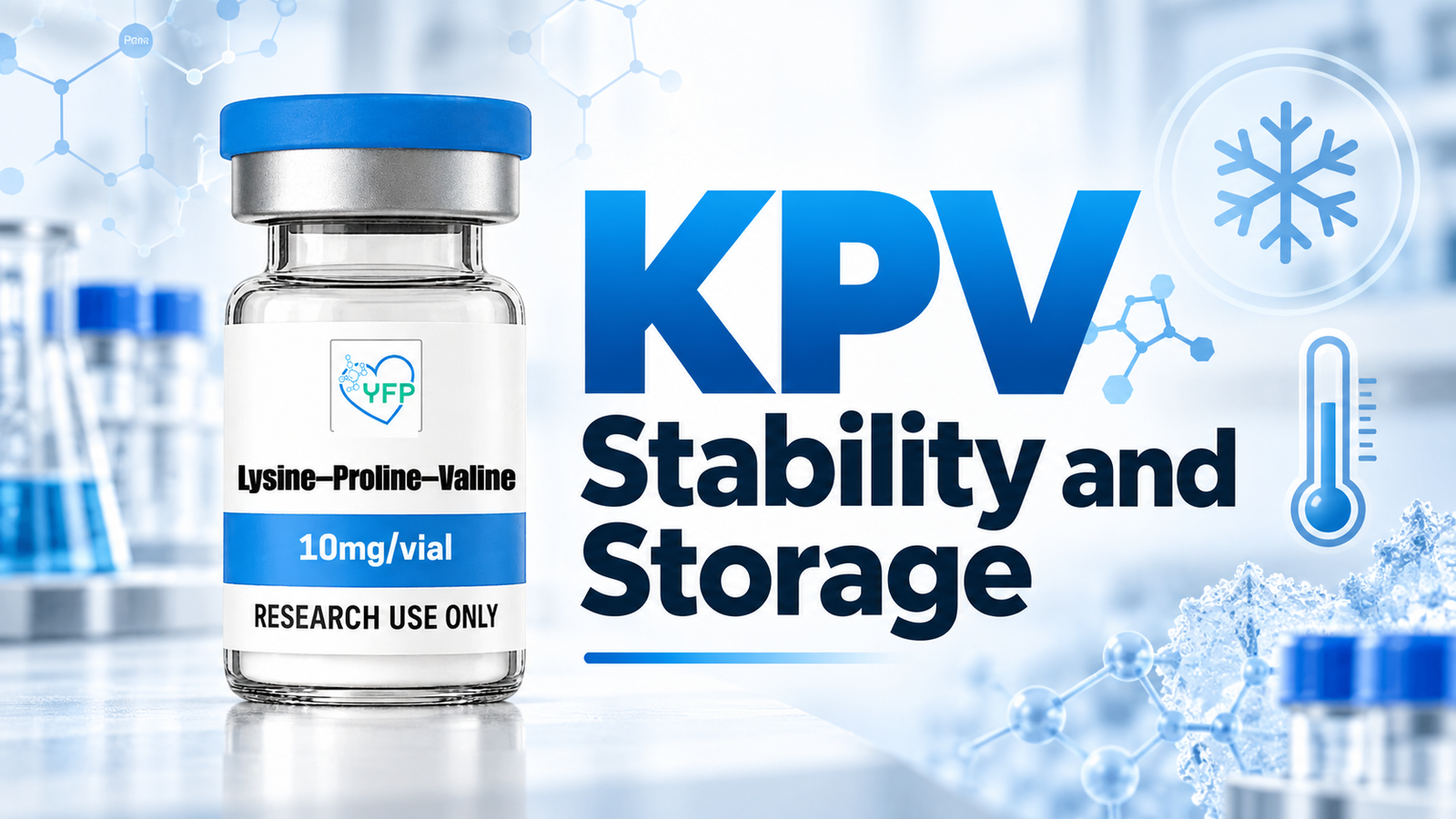
KPV Stability and Storage: A Laboratory Research Guide
KPV stability and storage is a practical question every peptide researcher faces: you have a vial of lyophilized tripeptide, and you need it to remain intact until the experiment. The published literature on KPV offers two kinds of answers. The first is direct but sparse — stability findings from the KPV papers themselves, including the pronase-resistance work on modified analogs and the formulation studies built around the peptide’s vulnerability. The second is general laboratory practice for peptides: how lyophilized peptides are stored, why freeze-thaw cycles matter, and what degrades a peptide on the shelf. This KPV stability and storage guide combines both, framed strictly as laboratory practice — with no administration instructions of any kind.

Research-use-only disclaimer: KPV (Lys-Pro-Val) is not an FDA-approved drug and is not a medicine. It is handled as a research compound for laboratory and scientific investigation only. This article covers laboratory storage and stability practice. It contains no dosage information, no administration or reconstitution instructions for any use, and no medical advice.
KPV Stability and Storage: What the Literature Reports
Before the checklists, the direct evidence. The KPV stability and storage picture from published studies is really a story about vulnerability — and about what researchers did in response to it.
The baseline fact, stated qualitatively across the literature, is that free KPV — a small linear tripeptide — is susceptible to rapid enzymatic degradation. Peptidases in biological fluids cleave short peptides quickly; this is standard peptide biochemistry, and it is the reason so much of the KPV literature is delivery research in disguise. The nanoparticle and hydrogel studies (Laroui et al., 2010, PMID 19909746; Xiao et al., 2017, PMID 28143741) are, at their core, KPV stability and storage strategies for the in vivo environment: protect the peptide from enzymes long enough to reach the target tissue.
The most quantitative stability data comes from Songok et al. (PLoS One, 2018), who used reductive glycoalkylation of KPV’s lysine residue to create modified analogs — and then tested them against pronase, a broad-spectrum protease mixture. The modified tripeptides’ internal peptide bonds remained stable over several days, while the work’s framing made clear that the native peptide’s vulnerability was the problem being solved. For KPV stability and storage purposes, the inference is straightforward: the unmodified tripeptide is the fragile baseline; chemical modification is one route to a hardier molecule.
What “stability” means in this article: chemical integrity of the peptide — the fraction of intact Lys-Pro-Val remaining over time under given conditions — as distinct from biological activity. A peptide can lose activity without visible change, which is why KPV stability and storage practice centers on controlling temperature, moisture, light, and handling rather than on how the vial looks.
The Lab Storage Checklist: Lyophilized KPV
Most research peptides, KPV included, are supplied as lyophilized (freeze-dried) powder. Lyophilization removes water, and removing water arrests most degradation chemistry — which is why the dry powder is the stable form. The KPV stability and storage checklist for the unopened lyophilized vial follows standard peptide laboratory practice:
- Store cold and dry. Supplier documentation for research peptides commonly recommends long-term storage of lyophilized material at −20 °C, with −80 °C used in some research settings for extended storage. One published KPV certificate of analysis notes stability studies supporting ambient-temperature shipment, with long-term storage recommended at −20 °C — a pattern typical across the research-peptide market.
- Keep it sealed until use. Moisture is the enemy of lyophilized peptides: water re-enables hydrolysis and microbial growth pathways. Leave the vial sealed, with its desiccant if supplied, until the material is needed.
- Protect from light. Photodegradation is a documented peptide degradation route. Opaque or amber secondary containment, or simply a dark freezer, is standard practice.
- Allow temperature equilibration before opening. A cold vial opened in warm room air condenses moisture onto the powder — a small, avoidable insult. Standard practice is to let the sealed vial reach room temperature before breaking the seal.
- Document receipt and lot. Record the supplier, lot number, and receipt date. If a later experiment behaves unexpectedly, the first question is always whether the material changed — and the logbook is how you answer it.

The Handling Checklist: What Degrades Peptides
Once a vial is opened, KPV stability and storage becomes a handling discipline. The degradation routes below are general peptide chemistry — they apply to KPV as they do to any short peptide:
- Repeated freeze-thaw cycles. Each freeze-thaw stresses the peptide and concentrates solutes during freezing. The standard mitigation is aliquoting: dividing material into single-use portions so each portion is thawed once. This is the single highest-value habit in peptide KPV stability and storage practice.
- Moisture ingress. Every opening of a lyophilized vial admits humid air. Minimize open time, reseal promptly, and consider desiccated secondary storage.
- Elevated temperature. Degradation chemistry accelerates with temperature — the rough rule of thumb is that reaction rates roughly double with each 10 °C rise. Room-temperature bench time should be minimized and logged.
- Light exposure. As with storage, keep working material shielded where practical.
- Adsorption to surfaces. Small peptides can adsorb to certain plastics and glass, reducing the effective concentration in solution. Low-binding labware is the standard precaution in quantitative work.
- Microbial contamination. Aqueous peptide solutions without preservatives can support microbial growth. Aseptic technique during handling is standard laboratory practice.
Do this, not that — a quick reference: DO aliquot into single-use portions; DO store lyophilized material at −20 °C or below; DO equilibrate sealed vials to room temperature before opening; DO log lot numbers and dates. DON’T repeatedly freeze and thaw the same vial; DON’T leave lyophilized powder open on the bench; DON’T assume a clear solution means an intact peptide — degradation is invisible.
KPV Stability and Storage Conditions at a Glance
| Material state | Recommended condition | Typical stability horizon | Notes |
|---|---|---|---|
| Lyophilized, unopened | −20 °C, sealed, desiccated, dark | Often 2+ years per supplier documentation | Most stable form; ambient shipment commonly permitted |
| Lyophilized, unopened (extended) | −80 °C | Multi-year in research settings | Used where available; avoid if frequent access needed |
| Lyophilized, opened | −20 °C, resealed promptly | Reduced vs. unopened | Each opening admits moisture; minimize open time |
| In solution (aliquots) | Frozen in single-use aliquots | Weeks to months depending on conditions | Thaw each aliquot once; avoid refreezing |
| In solution (working) | Refrigerated, minimal bench time | Days at best | Peptidase and microbial vulnerability highest here |
A note on the table: the horizons are typical ranges from general peptide practice and supplier documentation, not KPV-specific measured values — no published study establishes a KPV shelf-life curve. Treat them as planning ranges, and verify material integrity analytically (e.g., HPLC) when an experiment’s validity depends on it. That verification step is the professional core of KPV stability and storage: trust the cold chain, but confirm the molecule.
Why Stability Shaped the KPV Literature
There is a satisfying symmetry in the KPV stability and storage story: the same fragility that makes the powder a careful-storage item is what drove a decade of formulation science. When Laroui and colleagues built colon-targeted nanoparticles (2010), when Xiao and colleagues functionalized them with hyaluronic acid (2017), and when Songok and colleagues glycoalkylated the lysine residue (2018), each team was solving a stability problem — protecting Lys-Pro-Val from enzymatic destruction long enough to do its reported work. Even the PepT1 uptake finding (Dalmasso et al., 2008, PMID 18061177) can be read in this light: rapid transport into cells is, among other things, a way to get the peptide out of the degradative extracellular environment.
For the bench researcher, the lesson is practical rather than philosophical. KPV rewards the same habits that all short peptides reward: cold, dry, dark, aliquoted, documented, and verified. The literature’s most sophisticated delivery systems are just elaborate versions of those habits, engineered for the inside of a living organism rather than the inside of a freezer.
A final caution on sourcing and storage: stability practice assumes the vial contained what the label claimed at receipt. Research-peptide quality varies between suppliers, and no storage protocol rescues mislabeled or degraded starting material. Source from suppliers explicit about research-use-only status and analytical documentation, such as certificates of analysis — and treat the CoA as the beginning of your KPV stability and storage records, not as a guarantee.
Key Takeaways: KPV Stability and Storage in Brief
Cold, dry, dark, aliquoted — the fundamentals cover KPV
KPV stability and storage follows standard short-peptide practice: lyophilized material at −20 °C or below, sealed against moisture, protected from light, divided into single-use aliquots, with freeze-thaw cycles avoided. No KPV-specific shelf-life curve has been published, so these are practice-based ranges, not measured guarantees. (Research framing only.)
The literature’s delivery science is stability science
Nanoparticles, hydrogels, and glycoalkylated analogs are the published literature’s answer to KPV’s enzymatic vulnerability — the in vivo counterpart of the freezer discipline described above. Both threads of KPV stability and storage point the same way: this is a molecule you protect. (Research framing only.)

Researchers building a peptide reference shelf may also want our selank vs semax research comparison and our research guides to Semax nasal spray and Selank nasal spray — all in the same research-use framing. We supply research compounds including Semax 10mg and Selank 10mg, strictly for laboratory research use.
KPV Stability and Storage: Frequently Asked Questions
Quick answers to the questions researchers ask most about keeping KPV intact.
How should lyophilized KPV be stored?
Standard peptide laboratory practice — the basis for KPV stability and storage guidance — is to keep lyophilized material sealed, desiccated, protected from light, and stored at −20 °C or below (−80 °C for extended storage where available). Supplier documentation for KPV commonly reflects these conditions. Indexed literature can be reviewed via PubMed.
How long does KPV remain stable?
No published KPV-specific shelf-life curve exists. General practice and supplier documentation suggest lyophilized peptides often remain stable for 2+ years at −20 °C when unopened and dry; in-solution stability is much shorter. Verify integrity analytically when experimental validity depends on it.
Why do researchers aliquot peptides?
Aliquoting — dividing material into single-use portions — avoids repeated freeze-thaw cycles of the same vial, which stress the peptide and concentrate solutes during freezing. It is the single highest-value habit in KPV stability and storage practice and in peptide handling generally.
What degrades KPV in the laboratory?
The general degradation routes for short peptides: moisture ingress into lyophilized powder, elevated temperature, light exposure, repeated freeze-thaw, adsorption to surfaces, and microbial contamination of aqueous solutions. KPV’s reported vulnerability to enzymatic cleavage (peptidases) is the same chemistry that motivated the published nanoparticle, hydrogel, and glycoalkylation work.
Can KPV be shipped at room temperature?
Published supplier documentation for KPV has noted stability studies supporting ambient-temperature shipment, with long-term storage at −20 °C upon receipt. Shipping tolerance and storage stability are different things — brief transit at ambient temperature does not change the long-term KPV stability and storage recommendation.
Where can researchers source KPV for laboratory use?
KPV is available from research-compound suppliers strictly for laboratory research use, with analytical documentation such as certificates of analysis. Our listings such as Semax 10mg and Selank 10mg follow the same research-use framing. The FDA’s drug information pages explain what approval status means. Nothing here recommends any human use.
KPV Stability and Storage: Final Research Notes
KPV stability and storage is ultimately a solved problem at the bench and an active research area in the body. In the freezer, the answer is unglamorous and effective: keep it cold, dry, dark, and divided, and check your material when it matters. In the literature, the answer is a decade of increasingly clever engineering — particles, gels, and modified backbones — all aimed at giving a fragile tripeptide a little more time.
Both answers share a premise worth stating plainly: KPV is a molecule you protect, not a molecule you take for granted. Researchers who internalize that — in their freezers and in their experimental designs — will get more out of the compound than those who treat the vial as inert powder. The KPV stability and storage discipline is small, but it is the foundation everything else in KPV research stands on.


