
Kisspeptin 10 is a short peptide with an outsized role in reproductive endocrinology research. As the minimal active fragment of the kisspeptin family, it switches on one of the most important signaling cascades in the body — the pathway that controls gonadotropin-releasing hormone (GnRH). This guide explains what kisspeptin-10 is, how it works, what researchers study it for, and the handling details that matter in the lab.
What Is Kisspeptin-10?
Kisspeptins are a family of peptides encoded by the KISS1 gene, first identified in 1996 in Hershey, Pennsylvania — the name is a nod to the town’s famous chocolate “Kisses,” with “ss” marking its original description as a suppressor sequence. The family includes kisspeptin-54 (also called metastin), -14, -13 and -10, all sharing the same C-terminal sequence that activates their receptor.
Kisspeptin-10 is the shortest of these fragments — just ten amino acids — yet it retains full activity at the kisspeptin receptor. That makes it the form most commonly used in laboratory research: small, well-defined, and potent at its target.
The Receptor: KISS1R (GPR54)
Kisspeptin-10 works by activating the kisspeptin receptor, KISS1R, historically known as GPR54. The receptor’s importance became clear in 2003, when two research groups independently showed that loss-of-function mutations in GPR54 cause hypogonadotropic hypogonadism — a failure to enter puberty. That discovery repositioned kisspeptin signaling from a cancer-research footnote to the master switch of the reproductive axis.
Mechanism of Action: The GnRH Cascade
The pathway researchers study runs in a clean sequence:
- Kisspeptin-10 binds KISS1R on GnRH neurons in the hypothalamus.
- This triggers pulsatile release of GnRH.
- GnRH signals the pituitary to release LH and FSH.
- LH and FSH in turn regulate gonadal hormone production.
Because kisspeptin sits at the very top of this cascade, it gives researchers a precise tool for probing the whole axis — which is why kisspeptin-10 appears in studies of puberty onset, fertility signaling, and hypothalamic regulation. For a broader look at how upstream signaling peptides are used in study design, see our guide to peptide half-life and study scheduling.
What Is Kisspeptin-10 Studied For?
- Reproductive axis mapping — characterizing GnRH pulse generation and LH/FSH response patterns.
- Puberty and development research — activating KISS1 mutations are linked to precocious puberty; inactivating ones to delayed or absent puberty.
- Fertility science — kisspeptin analogs have been explored in assisted-reproduction research as an alternative trigger for egg maturation, including a notable line of trials using kisspeptin-54.
- Metabolic-reproductive interaction — KISS1 neurons integrate leptin and energy-balance signals, making kisspeptin-10 a probe for how metabolism gates reproduction.
- Oncology history — the original KISS1 discovery was as a metastasis suppressor in melanoma, a separate research thread that predates the endocrine work.
Half-Life and Handling in the Lab
Kisspeptin-10 is a small, unmodified peptide, and like most of its class it is degraded quickly by peptidases — published pharmacokinetic work puts its circulating half-life in the range of minutes rather than hours. Two practical consequences follow for researchers:
- Study designs typically use infusion or repeated administration models rather than assuming sustained exposure.
- Sample handling matters: lyophilized material should be stored frozen, protected from light, and reconstituted close to the time of use. Our peptide storage temperature guide covers the general standards.
Verifying a Kisspeptin-10 Research Sample
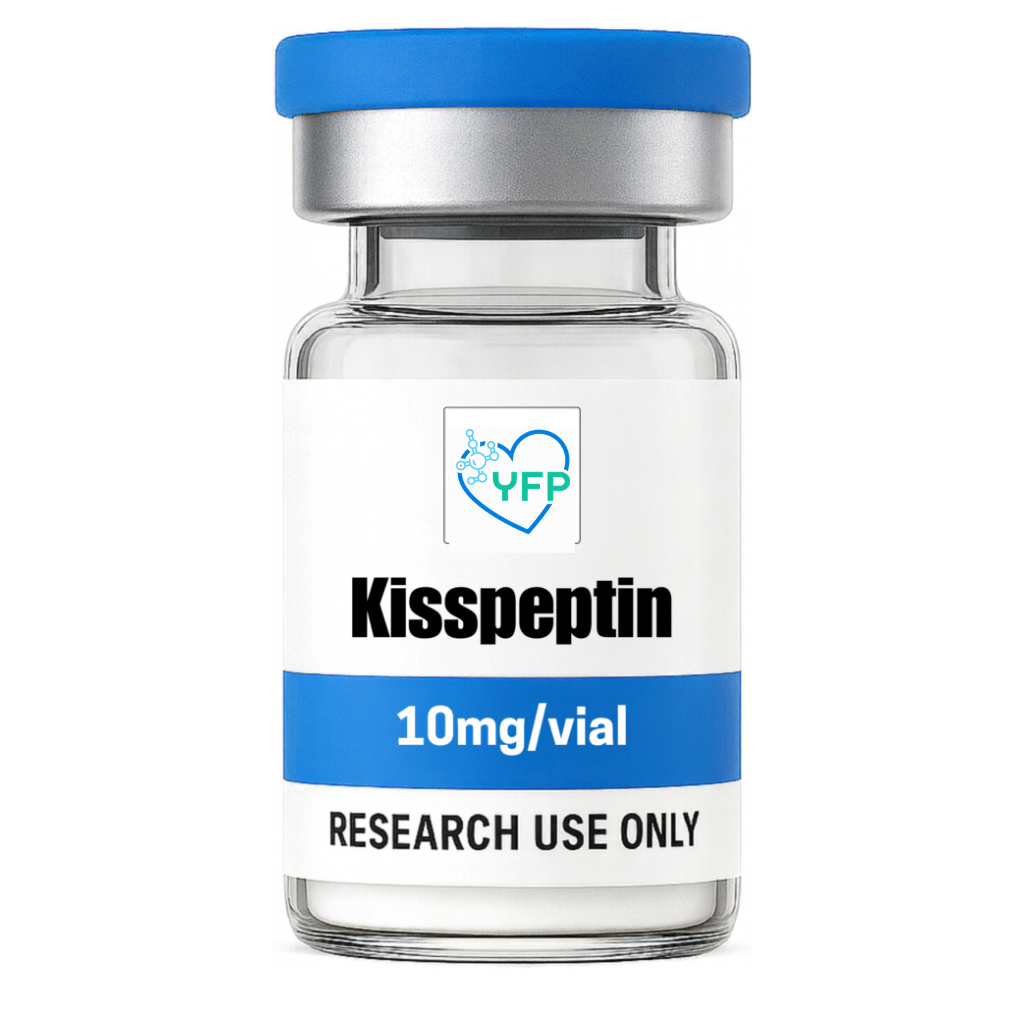
As with every research peptide, documentation is the quality signal: a lot-specific COA with HPLC purity of 99% or higher and mass-spectrometry identity confirmation, on a sealed, lyophilized vial with batch traceability. Our Kisspeptin-10 10mg listing follows that standard, with its batch documentation published in our COA library.
Frequently Asked Questions
What is kisspeptin-10?
Kisspeptin-10 is the ten-amino-acid active fragment of the kisspeptin peptide family. It activates the KISS1R (GPR54) receptor and is the form most widely used in reproductive endocrinology research.
How does kisspeptin-10 work?
It binds KISS1R on hypothalamic GnRH neurons, triggering GnRH release, which drives pituitary LH and FSH secretion — the top of the reproductive hormone cascade.
What is kisspeptin-10 researched for?
Primarily for mapping the reproductive axis: GnRH pulsatility, puberty onset, fertility signaling, and the interaction between metabolic state and reproduction.
What is the half-life of kisspeptin-10?
Short — on the order of minutes in circulation, because the unmodified peptide is rapidly broken down by peptidases. Research designs account for this with infusion or repeated-dose models.
How should kisspeptin-10 be stored?
Sealed and frozen in lyophilized form, protected from light, and reconstituted shortly before use in the laboratory.
Bottom Line
Kisspeptin 10 condenses one of endocrinology’s most important signaling systems into a ten-amino-acid research tool. Understanding its receptor, its cascade and its short half-life is the foundation for reading — or designing — any study that uses it.
All products referenced are supplied for laboratory research use only. Nothing in this article is medical advice.