Few research peptides have a documented history as long as the one traced in this GHK-Cu research timeline. From a 1973 plasma isolation to modern gene-expression analyses, GHK-Cu — the copper complex of the tripeptide glycyl-L-histidyl-L-lysine — has accumulated over fifty years of published investigation across wound healing, skin remodeling, copper biology, and genomics. This GHK-Cu research timeline walks through the key studies and milestones in chronological order: what was discovered, when, and how each finding shaped the next era of research. Research framing throughout — this is a literature history, not usage guidance, and GHK-Cu is not an FDA-approved drug.
Research-use-only disclaimer: GHK-Cu is not an FDA-approved drug. It is handled as a research compound for laboratory and scientific investigation only. All products are sold strictly for laboratory research use. This article contains no dosage information, no administration instructions, no before/after claims, and no medical advice.
What GHK-Cu Is: The Molecule Behind the Timeline
Before the chronology, the molecule. GHK-Cu is the copper(II) complex of the tripeptide glycyl-L-histidyl-L-lysine — three amino acids with a strong affinity for copper ions, readily forming the GHK-Cu complex that is considered its primary biologically active form. It is naturally occurring: found in human plasma, saliva, and urine. The GHK-Cu reference entry describes it as a naturally occurring copper complex of the tripeptide, first isolated from human plasma. Everything in the GHK-Cu research timeline below flows from that identity — a small, endogenous, copper-binding peptide whose research history now spans five decades.
GHK-Cu Research Timeline: The Milestones
1973 — Discovery in human plasma
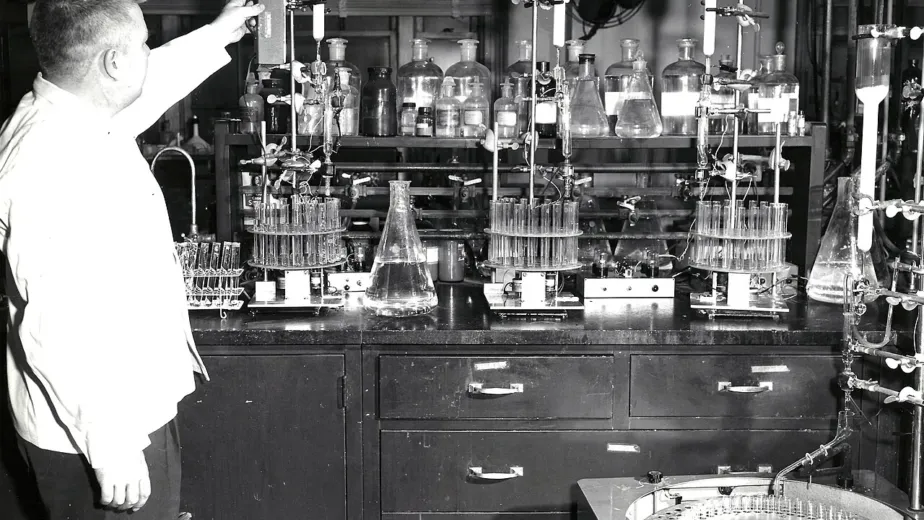
The GHK-Cu research timeline begins with Dr. Loren Pickart, whose research was sparked by an observation about aging liver tissue: liver cells from older individuals (aged roughly 60 to 80) showed elevated fibrinogen, but when incubated in blood from younger individuals, the older cells began to function and synthesize proteins like younger tissue. The hypothesis — a small circulating factor in younger blood — led to the isolation of the active molecule from the albumin fraction of human plasma: the tripeptide GHK. Published in Nature: New Biology in 1973, this is the founding paper of the entire field.
1974 — The copper complex is described
One year later, Pickart and Thaler published in FEBS Letters describing the copper complex itself. Further research established that GHK has a strong affinity for copper(II) ions, readily forming the GHK-Cu complex — the form considered biologically active. This was the first step from “a tripeptide in plasma” to “a copper peptide,” and it set the mechanistic agenda for the decade that followed.
1980 — Copper transport mechanism proposed
The mechanistic foundation arrived in 1980, when Pickart and colleagues published in Nature proposing that GHK functions by facilitating copper uptake into cells. This established a key idea that still anchors the literature: GHK acts as a copper carrier rather than a conventional receptor ligand. Free copper is toxic; bound to GHK, it can be delivered into cells where copper serves as a cofactor for enzyme systems including lysyl oxidase (collagen crosslinking), superoxide dismutase (antioxidant defense), and cytochrome c oxidase (cellular respiration). The structure was later confirmed through X-ray crystallography, EPR spectroscopy, X-ray absorption spectroscopy, and NMR.
1980s — Wound healing and the collagen connection
By the late 1980s, the GHK-Cu research timeline had entered its wound-healing era. Research by Pickart and others demonstrated that GHK-Cu could accelerate wound healing and contraction, improve skin transplant success, and showed anti-inflammatory properties — work that led to wound-healing patents. A second crucial insight emerged: the GHK sequence was discovered to be present in collagen itself, leading to the hypothesis that the peptide is released during tissue injury to signal the initiation of healing. In France, Maquart and colleagues showed that at very low, nontoxic concentrations (in the nanomolar range), GHK-Cu stimulated both the synthesis and breakdown of collagen and glycosaminoglycans — the controlled remodeling balance that became central to later skin research.
1998 — Topical collagen study in humans
A frequently cited human study: Abdulghani et al. (1998) compared topical GHK-Cu against vitamin C and retinoic acid for collagen production in a group of 20 women. GHK-Cu outperformed both comparators in this small study — a finding that is notable but limited by its size, and that should be read as a single data point rather than a settled verdict. It belongs in the GHK-Cu research timeline as the most-quoted human comparison, with its limitations stated alongside its results.
2003 — Ischemic wound healing in animal models
Topical GHK-Cu was reported to accelerate healing of ischemic wounds in rats, with decreased MMP-2, MMP-9, and TNF-alpha compared with untreated wounds. The matrix metalloproteinase (MMP) finding matters: MMPs remodel tissue, but in excess they drive destructive remodeling and scarring. GHK-Cu’s association with regulated MMP levels became part of the mechanistic story — remodeling that favors organized repair over fibrotic scarring.
2010–2014 — The gene-expression era
The most-cited modern chapter of the GHK-Cu research timeline is genomic. Using the Broad Institute’s Connectivity Map database, Pickart and colleagues analyzed how GHK affects human gene expression and reported modulation of approximately 4,000+ human genes — roughly 6% of the human genome — with a 2014 analysis in the journal Gene refining the picture. The reported pattern was not random: GHK shifted expression toward profiles associated with younger, healthier tissue — upregulating DNA repair, antioxidant defense, and stress-response genes while suppressing pro-inflammatory and tissue-destruction–associated genes. These are cell-culture findings, and the gap between gene-expression data and clinical outcomes remains the central open question of this era.
2018 — Tissue-remodeling gene analysis
Pickart and Margolina published data reporting that GHK-Cu modulates roughly a third of tissue-remodeling genes — extending the genomic story from general gene counts to the specific gene families most relevant to repair. Again, in vitro data: highly cited, but laboratory findings rather than clinical proof.
2021 — Gene effects in cancer cell lines
Pickart and Margolina published a gene-profiling paper on GHK-Cu’s effects in MCF7 breast cancer and PC3 prostate cancer cells (OBM Genetics, 2021), reporting modulation of cancer-related gene signatures and reviewing laboratory evidence on tissue-integrity mechanisms. This belongs in the GHK-Cu research timeline as the field’s extension into oncology-adjacent gene research — strictly laboratory work, and described here only as published findings, not as any therapeutic claim.
The Age-Decline Observation
One thread running through the later GHK-Cu research timeline is the commonly cited observation that plasma GHK concentrations decline with age — frequently quoted as roughly 200 ng/mL at age 20 versus roughly 80 ng/mL by age 60. Researchers have noted that this decline tracks with reduced regenerative capacity in aging tissue, but the relationship is correlational; a causal link between declining GHK levels and aging phenotypes has not been proven. The distinction between correlation and causation is worth stating explicitly, because the age-decline figure is one of the most repeated — and most over-interpreted — numbers in the GHK-Cu literature.
How the Eras Connect
Read as a whole, the GHK-Cu research timeline has a clear logic. The 1970s established the molecule and its copper chemistry. The 1980 paper proposed the copper-transport mechanism. The 1980s applied it to wound healing and uncovered the collagen connection. The late 1990s and 2000s tested it in human and animal skin/wound models. And the 2010s reframed everything in genomic terms — thousands of genes, shifted toward younger profiles. Each era reinterpreted the previous one’s findings at a deeper level of mechanism, which is how a healthy research program is supposed to work.
It is also worth noting what the timeline does not contain: GHK-Cu is not an FDA-approved drug, and the literature’s own reviews note the surprising absence of large clinical trials relative to the volume of laboratory data. That gap — fifty years of mechanism data, limited clinical confirmation — is the honest context for everything on this timeline. Readers exploring peptide research literature more broadly may find our selank vs semax research comparison useful for the same kind of structure-first, evidence-second reading discipline, and our GHK-Cu mechanism of action guide examines the proposed pathways behind the milestones above in detail. Companion format overviews — Semax nasal spray and Selank nasal spray — apply the same research-use framing to other compounds in our research catalog, which includes listings such as Semax 10mg and Selank 10mg for laboratory research use.
| Era | Key milestone | Research focus |
|---|---|---|
| 1973–1974 | Isolation from plasma; copper complex described | Discovery and chemistry |
| 1980 | Nature copper-transport paper | Mechanism: copper delivery into cells |
| 1980s | Wound healing studies; collagen-sequence finding; Maquart nanomolar work | Tissue repair and remodeling |
| 1998–2003 | Human topical comparison; ischemic wound animal study | Skin and wound models |
| 2010–2021 | Connectivity Map genomics; tissue-remodeling genes; cancer cell-line profiling | Gene expression regulation |
Key Takeaways — GHK-Cu Research Timeline
- 1973: Pickart isolates GHK from human plasma (Nature: New Biology) — the founding discovery.
- 1974–1980: the copper complex is described (FEBS Letters) and the copper-transport mechanism proposed (Nature).
- 1980s: wound-healing research, patents, and the discovery of the GHK sequence in collagen — the injury-release hypothesis.
- 1998–2003: human topical collagen comparison and animal ischemic-wound studies with MMP/TNF-alpha findings.
- 2010–2021: the genomic era — ~4,000+ genes modulated, tissue-remodeling gene analyses, cancer cell-line profiling; all laboratory data with clinical translation still open.
- Research framing only: GHK-Cu is not an FDA-approved drug, and this timeline contains no usage guidance.
GHK-Cu Research Timeline: Frequently Asked Questions
Quick answers to the questions researchers ask most about the GHK-Cu research timeline.
When was GHK-Cu discovered?
GHK was first isolated from human plasma in 1973 by Dr. Loren Pickart, published in Nature: New Biology. The copper complex was described the following year (Pickart & Thaler, 1974, FEBS Letters). These two papers open the GHK-Cu research timeline.
What was the key mechanistic finding of the early research?
The 1980 Nature paper proposing that GHK functions by facilitating copper uptake into cells. This established GHK as a copper carrier rather than a conventional receptor ligand — the mechanistic idea that anchors the rest of the GHK-Cu research timeline.
What did the 1980s wound-healing research find?
Studies reported that GHK-Cu accelerated wound healing and contraction, improved skin transplant success, and showed anti-inflammatory properties. The same era produced the finding that the GHK sequence occurs in collagen, suggesting the peptide is released during tissue injury to signal healing.
What is the gene-expression research about?
Using the Broad Institute’s Connectivity Map, researchers reported that GHK modulates approximately 4,000+ human genes, shifting expression patterns toward profiles associated with younger, healthier tissue. This is cell-culture data; the gap between gene-expression findings and clinical outcomes remains the central open question.
Does GHK-Cu decline with age?
Plasma GHK concentrations are commonly cited as declining with age (roughly 200 ng/mL at 20 vs. roughly 80 ng/mL at 60). Researchers note this tracks with reduced regenerative capacity, but the relationship is correlational — causation has not been proven.
Is GHK-Cu FDA-approved?
No. GHK-Cu is not an FDA-approved drug and is handled as a research compound for laboratory investigation only. The literature itself notes the absence of large clinical trials relative to the volume of laboratory data. The FDA’s drug information pages explain approval status.
GHK-Cu Research Timeline: Final Research Notes
Fifty-plus years, five eras, one small copper peptide. The GHK-Cu research timeline runs from a plasma fraction in 1973 through copper chemistry, wound-healing patents, collagen biology, and finally into genomics — each era reinterpreting the last at a deeper mechanistic level. It is one of the longest continuous research histories in the peptide literature, and it reads as a genuine scientific program rather than a marketing narrative.
The honest coda is the one the literature provides itself: an enormous body of laboratory and mechanistic data, and a clinical evidence base that has not caught up. Held in that frame, the GHK-Cu research timeline is both impressive and incomplete — which is exactly what a real research history looks like.